
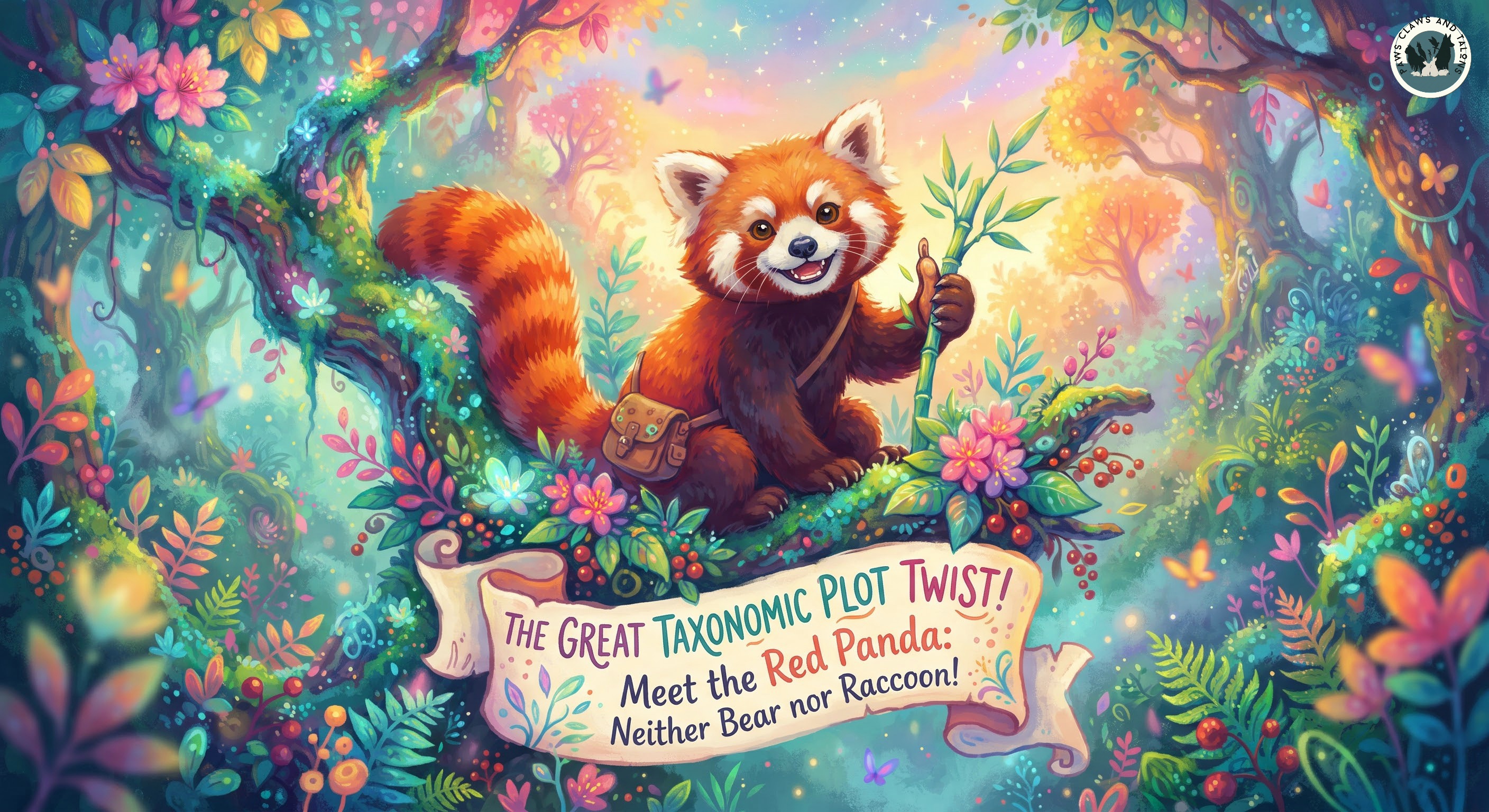
Welcome to the Ultimate Identity Crisis
If you gathered a committee of evolutionary biologists, a clever marketing team, and a handful of cartoon illustrators in a room, you might just end up with the red panda. With its rust-colored coat, theatrical white facial markings, and a tail so magnificently striped and fluffy it deserves its own zip code, this creature looks like a stuffed toy brought to life by enthusiastic magic. But step closer, dear reader, because beneath those soulful eyes lies one of the most delightful taxonomic identity crises in the animal kingdom.
For generations, scientists bounced the red panda around the family tree like a furry hot potato. Is it a bear? Is it a giant raccoon? Is it an overgrown tree-dwelling cat with an existential flair? As it turns out, the red panda is entirely in a league of its own.
Standing Alone in the Family Tree
Way back when taxonomists were first scratching their heads over classification, they noticed dental similarities with raccoons, then leaned toward bears, and eventually realized they were looking at a living ghost lineage. Today, the red panda is proudly crowned as the sole surviving member of its very own independent family, the Ailuridae.
That means while the giant panda sits comfortably in the bear family (Ursidae), our little red friend diverged from a common ancestor tens of millions of years ago. They share a distant cousin relationship with weasels, skunks, and raccoons, but they are genetically distinct isolationists who decided to branch off and master the art of looking adorable all by themselves.
Behold the Mighty False Thumb
One of the most fascinating evolutionary plot twists of the red panda is its toolkit for handling snacks. Since red pandas spend a staggering amount of their day munching on bamboo, they needed a specialized way to grip stalks, shoots, and leaves.
Enter the radial sesamoid bone—more affectionately known as the false thumb.
While it is not a true opposable thumb like ours, this modified wrist bone acts just like one. It gives red pandas a remarkable grip, allowing them to strip bamboo leaves with the precision of a gourmet chef prepping a delicate garnish. Who needs opposable thumbs built for holding smartphones when you have an engineered wrist bone specifically designed for supreme bamboo management?
Masters of the High-Altitude Canopy
Native to the temperate forests of the Eastern Himalayas and high mountain ranges, red pandas are built like natural winter mountaineers. Their thick, double-layered coats keep them warm when frost blankets the canopy, and their heavily furred soles provide built-in non-slip traction for icy branches.
When they sleep, they wrap that glorious, ringed tail around their noses like a luxurious built-in sleeping scarf. It is cozy, it is practical, and it inspires an immediate urge to take a nap.
Now that we have untangled the wonderful family tree of our favorite rust-colored acrobat, it is time to pack our virtual hiking gear. Stay tuned for our next installment as we journey up into the misty, high-altitude mountain forests to explore the breathtaking natural habitat where these canopy-dwellers call home!
Leave a Reply