
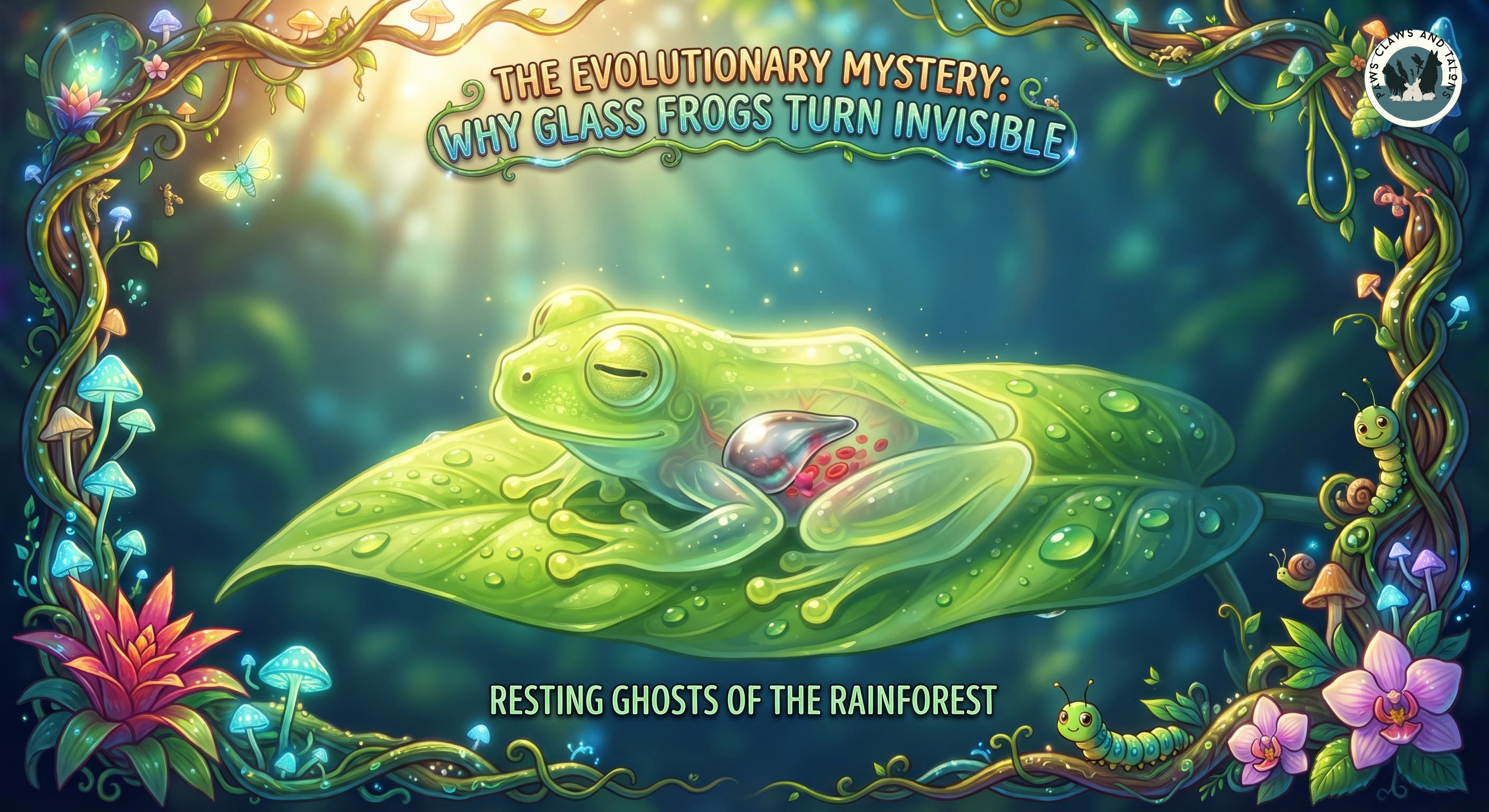
Welcome back, Chaos Wranglers and curious critters, to the second segment of our glass frog feature! In our last chapter, we marveled at the translucent skin that lets us peek right at their beating hearts and emerald bones. But today, we are diving straight into one of the coolest biological puzzles in the animal kingdom: how and why these little rainforest magicians manage to turn themselves completely invisible.
The Shadow Problem in the Canopy
Living high up in the tropical rainforest canopy means life is a constant game of hide-and-seek. When an arboreal frog sits on top of a bright green leaf during the daytime, the sun beats down from above. If that frog had a solid, opaque body, it would cast a dark, distinct shadow directly onto the leaf surface below. To a hungry bird, snake, or monkey scanning the foliage, that shadow acts like a glowing neon sign shouting “Frog for lunch!”
Nature had to find a clever engineering workaround for this illumination dilemma. Solid green coloring helps while the frog is active, but resting during daylight hours requires a much more advanced magic trick.
Packing Up the Red Blood Cells
For years, scientists scratched their heads trying to figure out how glass frogs solved the shadow problem. After all, blood has to carry oxygen, and blood is red and opaque. If your blood is pumping through your veins, your body is going to show up under X-ray-style lighting.
Enter the ultimate biological sleight of hand. Researchers discovered that when glass frogs settle down to sleep for the day, they pack nearly ninety percent of their red blood cells away inside their reflective liver! Because the liver is wrapped in a special reflective mirror-like tissue, it tucks away the opaque crimson cells while the rest of the body turns up to sixty-one percent more transparent. They essentially drain their outer blood vessels of color and hide the red pigment in a central vault, allowing light to pass straight through their bodies and scattering it so evenly that they cast virtually no shadow at all.
A Masterclass in Natural Camouflage
It is a stunning evolutionary adaptation that feels more like science fiction than biology. By turning off their color when vulnerability peaks, these little amphibians transform into living, breathing ghosts resting right in plain sight.
Stay tuned, Chaos Wranglers, because in our next installment, we are leaving the resting branches behind and heading out into the dark night to explore their high-flying tree-top lifestyles and nocturnal antics!
Leave a Reply