
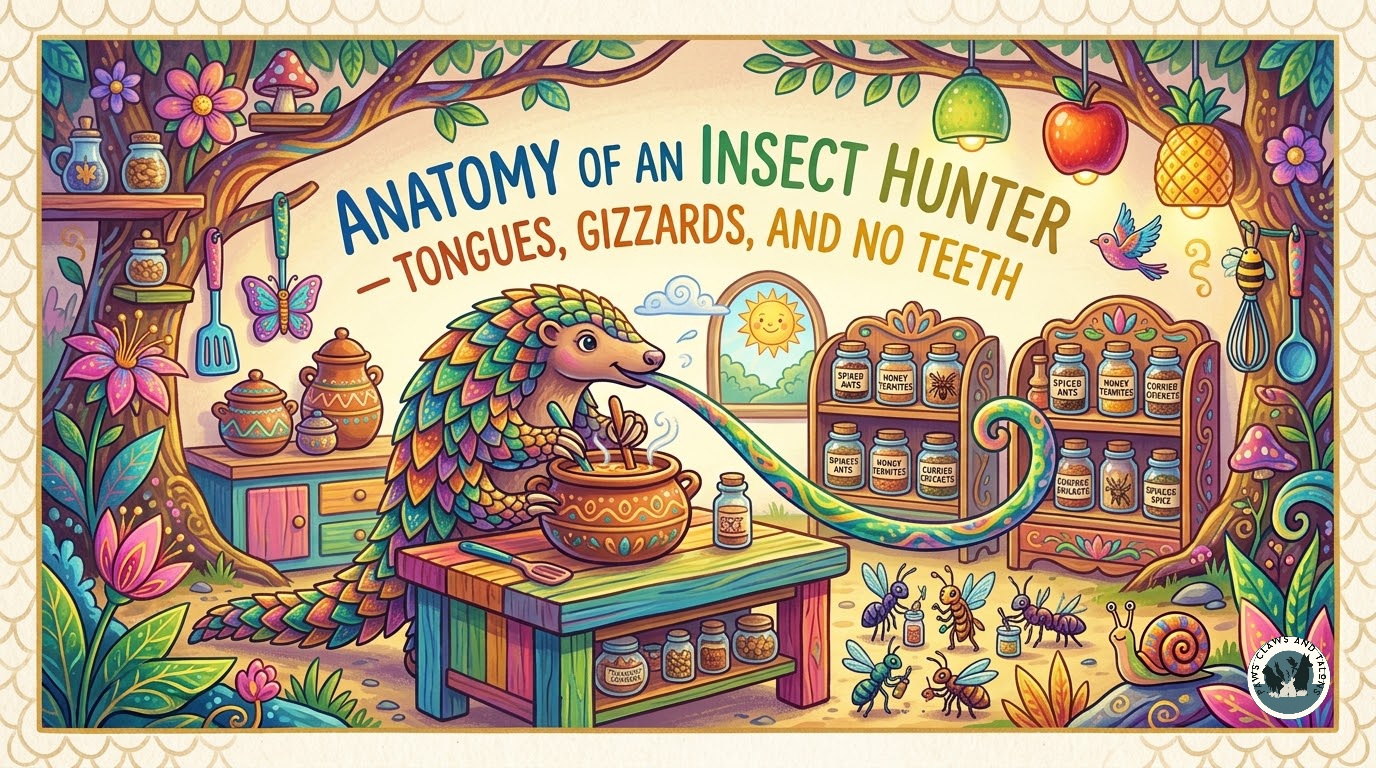
In Part 1, we explored the pangolin’s famous armor scales and quirky bipedal stroll. Now, let’s peel back another layer to uncover what makes this creature one of the most specialized insect predators in the animal kingdom.
If you engineered a machine designed solely to devour millions of ants and termites with surgical precision, it would look and operate almost identically to a pangolin.
A Tongue Rooted Near the Pelvis
The headline feature of pangolin internal anatomy is easily its tongue.
An adult pangolin’s tongue can stretch up to 16 inches (over 40 cm) long. To put that in perspective, when extended, the tongue is often longer than the animal’s head and body combined!
Where do you store a tongue that long? Instead of attaching at the back of the throat like most mammals, a pangolin’s tongue is rooted deep in its chest cavity, anchored near the sternum and pelvis. When not in use, the muscular tongue sheath rests inside the abdominal cavity.
Coated in thick, sticky saliva secreted by massive salivary glands, the tongue acts like living flypaper, trapping hundreds of panic-stricken insects in a single flick.
Zero Teeth? No Problem — Meet the Internal Gizzard
Despite being voracious predators, pangolins have completely lost the ability to chew. In fact, they have no teeth at all.
Instead, they rely on a specialized, highly muscular stomach lined with keratinous spines. To help grind up their meals, pangolins intentionally swallow small stones, sand, and pebbles while feeding. These swallowed stones sit in the gizzard-like section of the stomach, churning together to crush ant carapaces and termite exoskeletons just as a bird’s gizzard processes seeds.
An adult pangolin can consume an estimated 70 million insects per year, making them critical pest controllers that protect forests and agricultural lands from pest infestations.
Defense Against Angry Swarms
Attacking a nest containing thousands of biting soldier ants or stinging termites isn’t easy. Pangolins have evolved an array of specialized anatomical seals to protect themselves during a feeding frenzy:
- Pinhole Eyes & Thick Lids: Their eyesight is poor, but heavy eyelids keep angry insects from blinding them while foraging.
- Sealable Nostrils & Ears: Powerful specialized muscles seal their nostrils and ear canals tight during feeding, preventing stray insects from crawling inside.
- Thick Skin: The skin underlying their body scales is extraordinarily tough, resisting bites and stings that would drive other mammals away.
Combining powerful digging claws, a pelvic-anchored tongue, a rock-churning stomach, and built-in pest defense, the pangolin is a true master of its ecological niche.
Join us for Part 3 of our series, where we’ll take a tour across continents to meet “The Eight Sisters”—comparing the four African species with the four Asian species!
Leave a Reply