
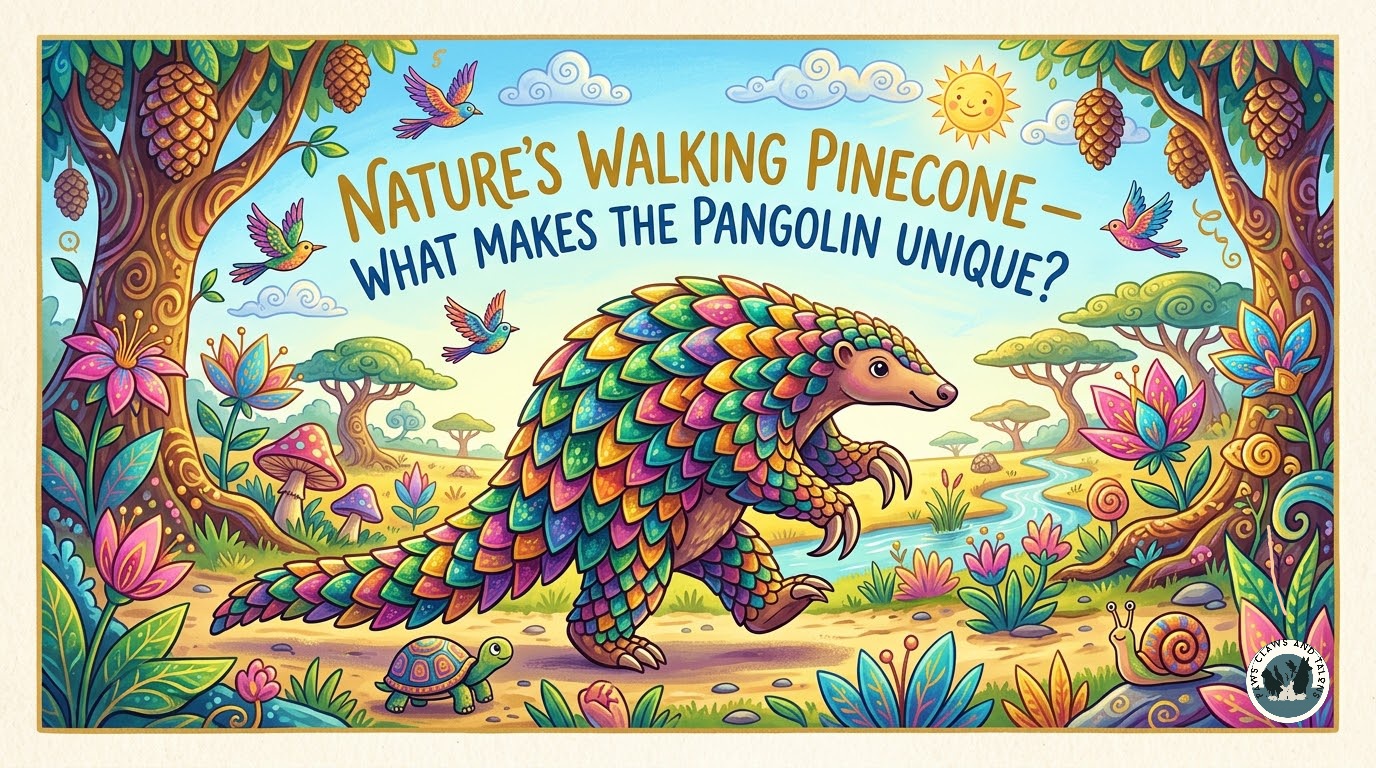
If you were asked to design an imaginary creature from scratch, you might come up with something like a pangolin. They look like a cross between a small dinosaur, a pinecone, and an artichoke. They walk with the awkward, polite posture of someone trying not to make noise while sneaking to the kitchen at night.
Despite their reptilian appearance, pangolins are mammals—and they happen to be one of the most evolutionarily distinct creatures walking the planet today.
The Only Scaled Mammal on Earth
Plenty of animals have specialized defense mechanisms, but pangolins take personal armor to an entirely new level. They are the only true scaled mammals in existence.
Those large, overlapping plates covering their bodies are made of keratin—the exact same tough protein found in human fingernails, horse hooves, and rhino horns. These scales grow continuously throughout a pangolin’s life and account for nearly 20% of its total body mass.
When threatened by predators like lions or leopards, a pangolin doesn’t run or bite. Instead, it relies on its Malay namesake, pengguling, which translates to “one who rolls up.” The pangolin tucks its head into its belly and wraps its muscular tail around its body, forming an impenetrable sphere of solid keratin armor. The edges of the scales are sharp enough that trying to unroll a defensive pangolin can slice right through predator paws.
The Polite Bipedal Stride
Beyond their armor, one of the most charming aspects of pangolin behavior is the way ground-dwelling species move.
When moving quickly or foraging across open ground, pangolins often rise up on their hind legs and walk entirely bipedally. Because their front claws are long, curved, and engineered specifically for digging into rock-hard termite mounds, walking flat on their front paws would dull or damage their essential tools.
To protect those digging claws, they tuck their front legs against their chest like a small, cautious dinosaur and use their heavy, muscular tails as a counterweight to balance each step. Watching a pangolin trudge through the savannah is equal parts fascinating and adorable.
An Evolutionary Wonder Worth Protecting
Pangolins belong to the order Pholidota, an ancient lineage that split from other mammal lines tens of millions of years ago. Though they share superficial similarities with South American anteaters and armadillos, genetic research shows they are actually more closely related to carnivores like bears, wolves, and seals.
They are living living relics of mammalian evolution, perfectly adapted to their environment in ways no other animal can replicate.
Stay tuned for Part 2 of our Pangolin Deep Dive, where we unpack the extraordinary internal biology of these insect hunters—including a tongue longer than their entire body and a stomach that acts like a gizzard!
Leave a Reply