
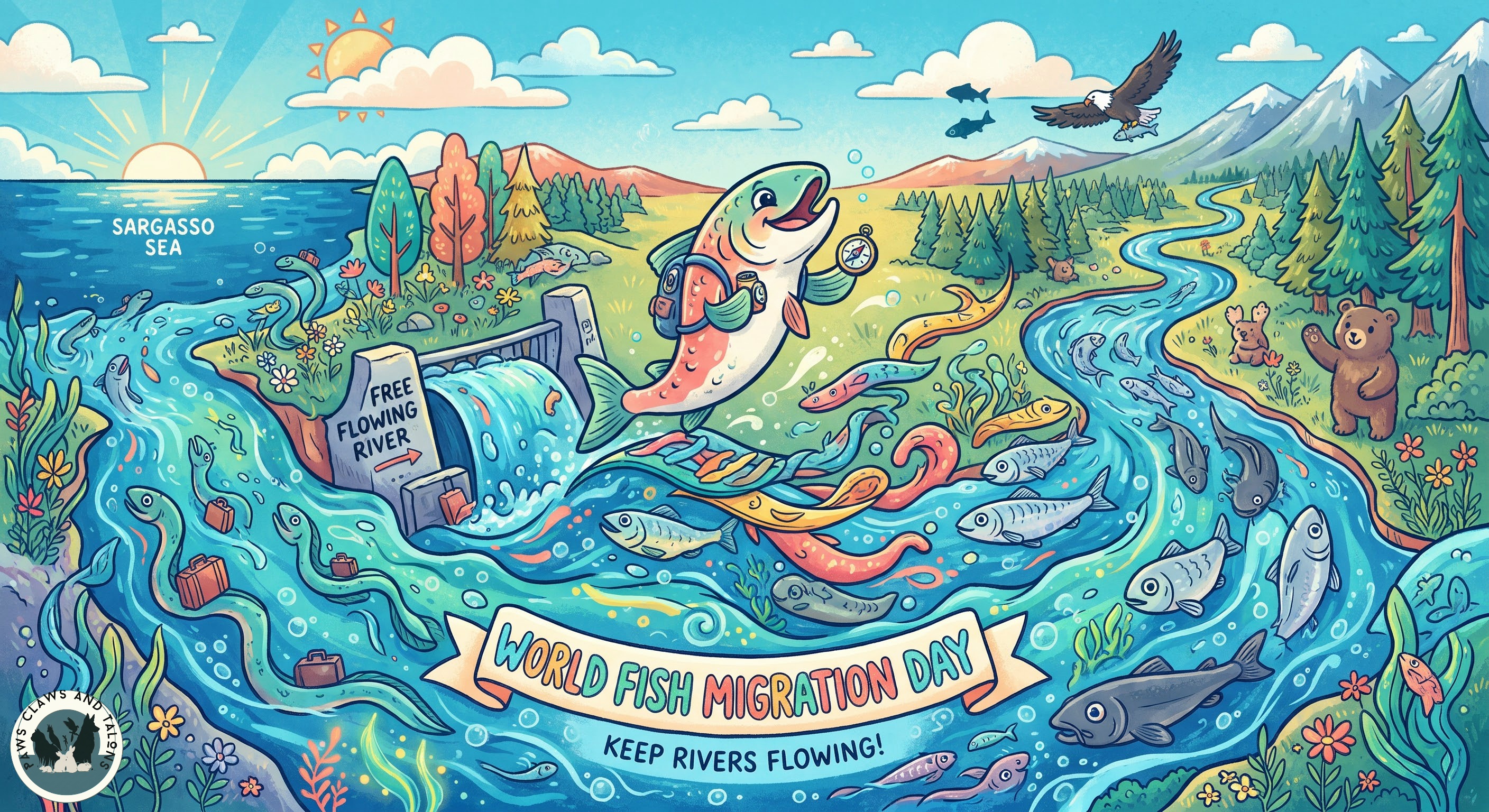
Grab your microscopic snorkels and prepare to swim upstream, because today is World Fish Migration Day! Yes, an entire global holiday dedicated to aquatic athletes who look at a raging waterfall, a thousand miles of open ocean, or a concrete dam and say, “Challenge accepted.”
While you might think fish migration is just a niche plot device for nature documentaries or an excuse for salmon to put on an impressive leaping display, it is actually the secret pulse keeping our entire planetary ecosystem alive. Without millions of fins on the move, our world would look a whole lot gloomier—and smell a lot less balanced.
Who Started This Fin-tastic Voyage?
Every great movement has a visionary, and for World Fish Migration Day, that visionary didn’t have gills—he just spent a lot of time worrying about the ones that do.
Back in the day (specifically starting as a local Dutch event and expanding globally in 2014), a visionary conservationist named Herman Wanningen looked at fragmented, dammed-up rivers and realized that fish needed a voice, or at least a clear pathway. He organized a local fish migration day in the Netherlands, expecting a few stray ecologists and maybe an enthusiastic duck. To everyone’s absolute shock, a thousand people showed up.
Realizing that humanity had a hidden soft spot for traveling fish, the movement exploded into a worldwide phenomenon coordinated by the World Fish Migration Foundation and partners. It became an international rallying cry to remove obsolete dams, punch holes through barriers, and let rivers run wild and free once more.
Why Should We Care? (The Ecosystem Gossip)
You might be sitting on your dry, land-locked couch thinking, “What do swimming creatures have to do with me?” As it turns out, migratory fish are essentially the ultimate freelance delivery drivers of the natural world.
They connect fractured habitats by moving nutrients across massive distances. Take salmon, for example. They feast out in the salty ocean, pack themselves full of marine nutrients, and then swim thousands of miles upstream to spawn and—let’s be honest—retire. When they arrive, they nourish everything from bears and eagles to the deep forest soil itself, acting as flying-to-table organic fertilizer. When rivers are blocked by human meddling, these nutrient delivery loops break down. Forests lose their fertilizer, other wildlife goes hungry, and aquatic ecosystems start to flatline.
The A-List Swimmers vs. The Underappreciated Commuters
When we talk about migration, everyone immediately pictures the celebrities of the fish world. But there is a whole cast of characters keeping the rivers churning, from the superstars to the unsung heroes.
The A-List Headliners
- Salmon: The undisputed rockstars of the river. They navigate back to the exact gravel bed where they hatched, defying gravity, waterfalls, and overly optimistic grizzly bears just to keep the family tree going.
- Eels: The enigmatic contrarians. While salmon go from fresh water to salt water, eels do the complete opposite. American and European eels live most of their lives in cozy rivers before booking a one-way, trans-oceanic luxury cruise to the Sargasso Sea just to spawn in the deep dark blue.
The Underappreciated Everyday Commuters
- River Herring and Shad: These guys might not get blockbuster movies made about them, but they are the literal snack-bars of the coastal ecosystem. Their massive seasonal runs feed everything in the estuary, supporting larger fish, seabirds, and local marine economies.
- Freshwater Migrants (Like certain Catfish and Carp): They don’t necessarily go to the ocean, but they travel hundreds of miles up and down winding river networks just to find the right temperature, look for love, or find a decent snack.
When we slap a concrete dam across their local highway, it ruins their entire daily commute.
Let’s Keep the Waters Flowing
At the end of the day, World Fish Migration Day isn’t just about celebrating scaly travelers; it’s a reminder that we share this plumbing system called Earth. When rivers flow freely, fish thrive, ecosystems balance out, and the whole planet breathes a little easier.
So, next time you cross a bridge over a local river, tip your hat to the water below. Somewhere down there, a very determined fish is packing its bags, dodging an old boot, and getting ready to change the world one fin-flap at a time.
Leave a Reply