
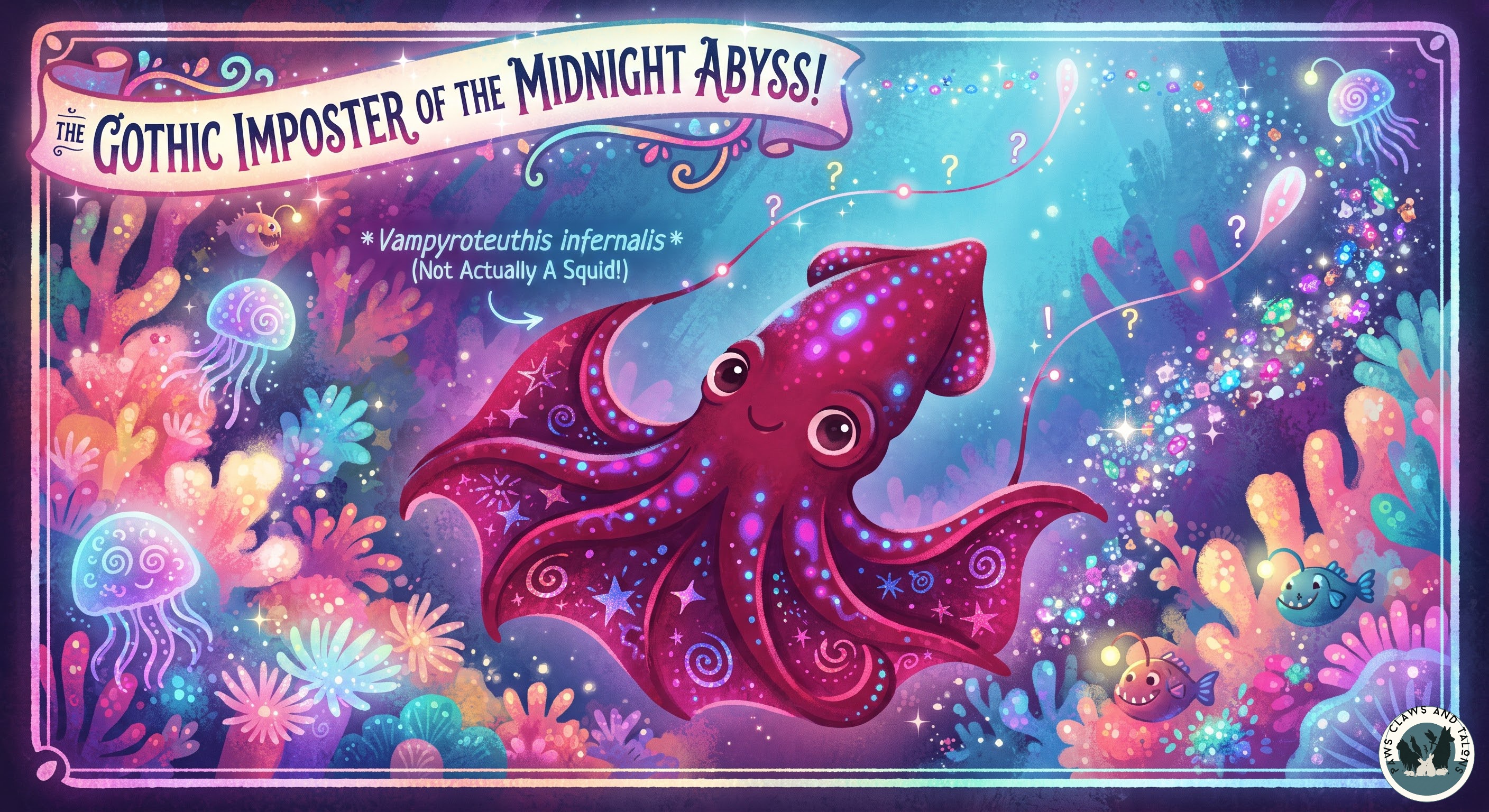
Why This ‘Squid’ Refuses to Fit In
Welcome back, Chaos Wranglers, to the kickoff of our grand, week-long deep dive! All this week, we are plunging headfirst into the delightfully eccentric, shadowy world of a creature that sounds like it wandered straight out of a Victorian ghost story and straight into the crushing pressure of the deep: the vampire squid (Vampyroteuthis infernalis).
Despite its wonderfully melodramatic scientific name—which literally translates to “vampire squid from hell”—this deep-sea phantom has zero interest in cape-wearing villainy or late-night dramatics. Instead, it is the ultimate misunderstood introvert of the ocean, proving you do not need to bite anyone to be absolute royalty of the abyss.
The Fashionably Confused Identity Crisis
Let us clear the air right off the bat: this creature is an absolute imposter in the best possible way. While everybody and their mother insists on calling it a squid, our glamorous friend refuses to conform to peer pressure, opting instead to sit alone in its own exclusive, VIP order called Vampyromorphida. Think of it as a stubborn evolutionary relict, an ancient living fossil that casually bridges the gap between octopuses and squids without committing to either team.
Unlike modern squids that belong to the fast-paced Decapodiformes crowd, our vampire star is the sole surviving member of its ancient club, having branched off from its cephalopod ancestors millions of years ago. It carries mixed baggage from both sides of the family tree, proving once and for all that evolution is never a neat ladder—it is a delightfully chaotic treehouse.
Anatomy of a Professional Rule-Breaker
When you inspect its physical blueprint, the confusion only gets more charming. It features eight glorious arms connected by a delicate web of skin—giving it that iconic, dramatic gothic cape look—paired with two secret, retractable sensory filaments that it tucks away like hidden party tricks.
Instead of the sticky suction cups lining the arms of your standard-issue squid or octopus, the vampire squid rocks fleshy, rounded little bumps called cirri along the inner edges of its webbed cape, which it uses to gently shepherd meals toward its beak. And those two retractable filaments? They are purely high-tech sensory antennas, packed with touch and chemical receptors to help it navigate absolute, pitch-black nothingness.
Why This Ancient Rebel Still Rules
As we launch into our seven-part expedition this week, getting our heads around this bizarre taxonomy gives us a front-row seat to prehistoric survival. The vampire squid didn’t recently decide to get weird; it represents an ancient lineage that survived mass extinction events by simply retreating into the pitch-black, high-pressure quiet of the deep sea while everyone else was busy evolving into speedy, high-metabolism show-offs in the shallow waters.
Stay tuned as our multi-part journey continues tomorrow, when we investigate the crushing, oxygen-starved real estate where this phantom calls home!
Leave a Reply