
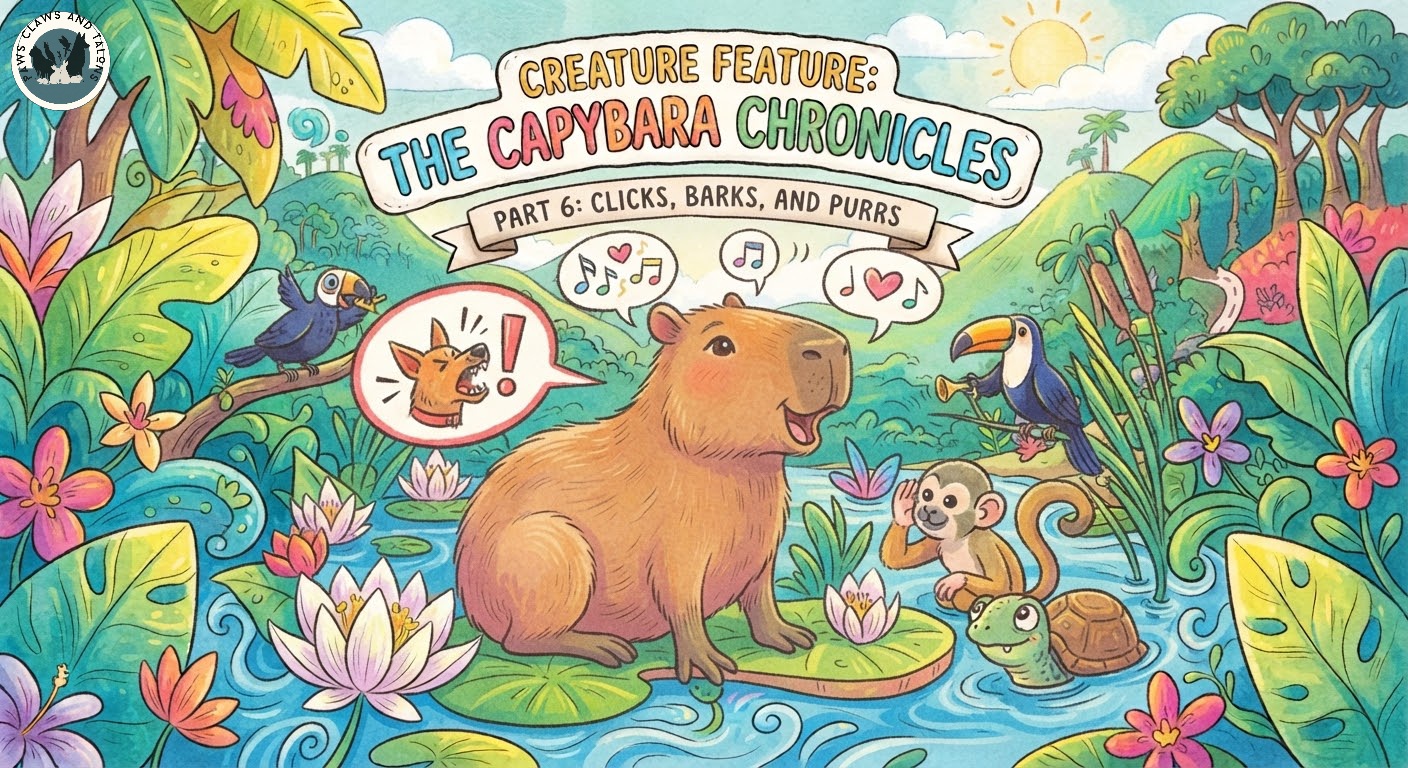
The Secret Language of Capys
Welcome back, wildlife detectives, to the grand finale of our capybara chronicles! Over the past five chapters, we’ve marveled at their giant rodent anatomy, mapped out their soggy South American real estate, explored their eccentric digestive hacks, compared jungle survival to luxury living, and celebrated their unmatched status as the ultimate animal roommate. Today, we are turning up our audio receivers to decode the surprisingly complex conversational vocabulary of these gentle river giants.
The Symphony of the Wetlands
Because capybaras live in tight-knit herds where safety depends entirely on teamwork, communication is absolute key. You might assume that a 140-pound furry potato operates primarily in silence, but these social creatures actually possess a rich, diverse musical repertoire. When a herd gathers along a muddy riverbank, they are constantly chatting, gossiping, and checking in with one another using a fascinating array of vocalizations.
If you hang out near a capybara family, you will quickly notice a series of soft, rhythmic clicks and low-pitched purrs. These are the sweet sounds of contentment and social bonding, often used by mothers communicating with their young or by herd members letting everyone know that all is peaceful in the marsh. It is essentially the capybara equivalent of a gentle hum or a cozy chat over coffee.
Sounding the Alarm
Of course, not every sound in the wetlands is a relaxation tune. When danger approaches—whether it’s an on-the-prowl jaguar, a lurking caiman, or an unexpected human intruder—the mood changes instantly.
A sentinel capybara on patrol will emit a sudden, sharp, dog-like bark. This single acoustic warning shot cuts through the air like an alarm bell, instantly sending the entire herd scrambling for the water’s edge to execute a synchronized tactical dive. Once submerged, they use underwater clicks and grunts to coordinate their movements until the coast is clear. From barrel-shaped body architecture to complex conversational chattering, capybaras prove that the rodent world is full of brilliant surprises!
The Final Takeaway: Channel Your Inner Capy
So, what have we learned from our grand tour of the world’s largest rodent? Capybaras teach us that you don’t need to be aggressive to rule your corner of the world. Sometimes, the winning strategy in life is to keep a tight squad, maintain a brilliant digestive recycling system, treat every passing bird like a personal spa attendant, and respond to life’s chaos by calmly sliding into the nearest body of water. Stay chill, keep exploring, and remember to look out for your herd!
Leave a Reply