
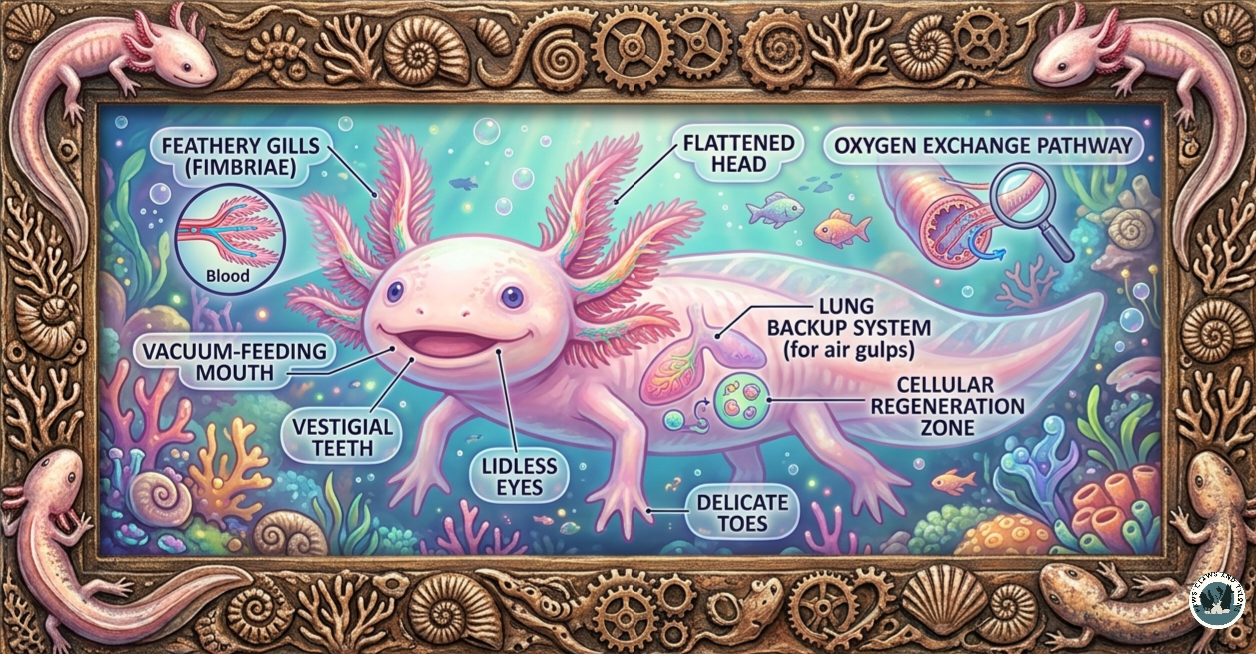
Welcome to Part 4 of our Axolotl Spotlight! We’ve covered their origin, their unique “eternal youth” (neoteny), and their mind-blowing ability to regenerate limbs. Today, we’re taking a closer look at what makes this fully aquatic salamander tick, from its characteristic wide smile to its most iconic feature: those incredible, feathery gills.
An Anatomy Designed for the Deep
The axolotl’s entire body is a masterpiece of aquatic engineering, perfectly adapted for life at the bottom of ancient Mexican lakes. It’s important to remember they are not fish, but fully aquatic salamanders.
Starting at the front, the first thing you notice is that wide, permanently smiling mouth. This is not for happy expressions but for buccal pumping. Axolotls don’t chew; they snap their mouths open to create a vacuum, sucking in water and prey (like small crustaceans, insect larvae, and worms) in one swift gulp.
Behind the smile are vestigial teeth—not for biting, but for gripping prey. They have lidless eyes (common in fully aquatic species) and a flattened head designed to move through the water efficiently. Their four slender legs, with delicate fingers and toes, are used for walking along the lakebed rather than for powerful swimming.
The Crown Jewel: Feathery External Gills
Now, let’s talk about those stunning, branch-like structures that frame their faces like an underwater crown. These are external gills. Unlike most amphibians that develop internal gills as larvae and then lungs as adults, the axolotl retains its external gills throughout its entire life due to neoteny.
Why are they external? It increases the surface area for oxygen absorption from the water. Those thousands of tiny, feathery filaments are called fimbriae. Blood flows through these filaments, bringing red blood cells very close to the water where they can directly exchange carbon dioxide for dissolved oxygen.
When you see an axolotl gently “flick” its gills, it’s not just a cute twitch. It’s clearing the fimbriae of debris and circulating fresh, oxygen-rich water past the filaments, ensuring maximum breathing efficiency.
A Backup Plan: Breathing with Lungs
Interestingly, axolotls also possess lungs. This is a crucial evolutionary safety net. While they get about 80–90% of their oxygen from their gills, their lungs provide a backup system.
You might occasionally see your axolotl float to the surface, take a quick gulp of air, and dive back down. This is pulmonary breathing. This ability likely served their ancestors well in the potentially low-oxygen, fluctuating environments of Lake Xochimilco, allowing them to supplement their aquatic breathing with atmospheric air.
The axolotl’s anatomy is a fascinating blend of features that define their unique identity as the “eternal juvenile,” combining an archaic appearance with specialized survival tools. Tomorrow, in Part 5, we’ll transition from anatomy to care, focusing on how to set up the perfect aquatic habitat to keep these biological wonders healthy!
Leave a Reply