
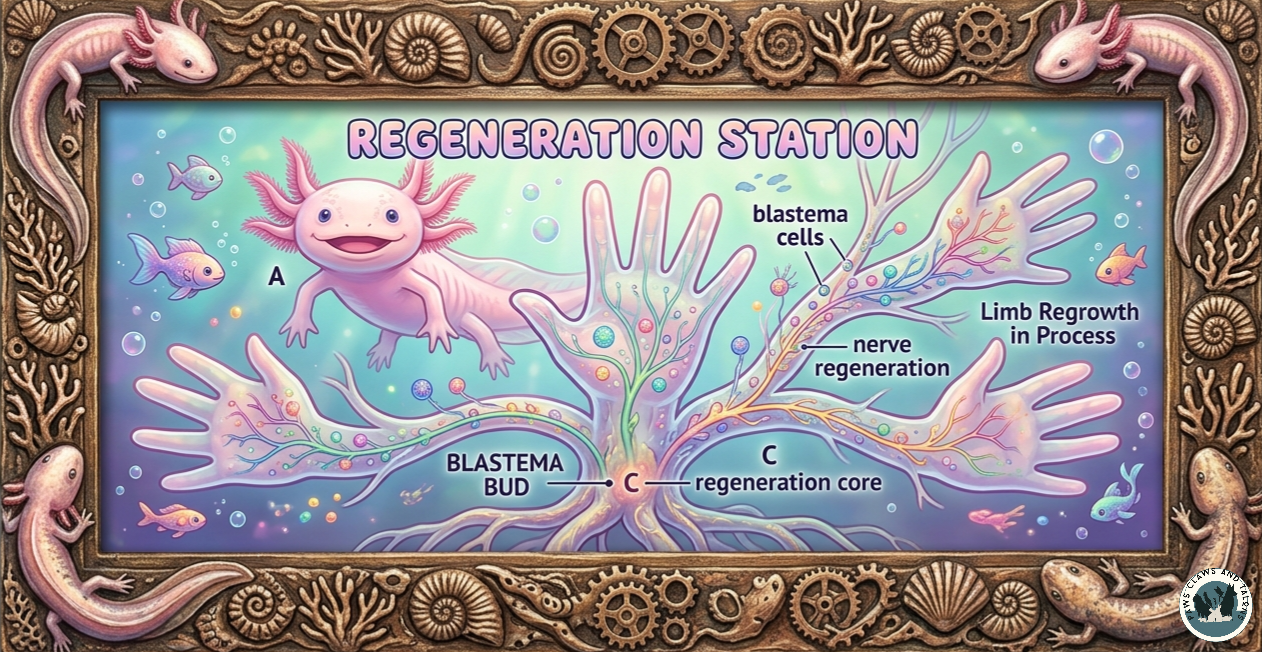
Welcome to Part 3 of our Axolotl Spotlight! Yesterday, we explored neoteny—the fascinating evolutionary trait that allows the axolotl to remain an eternal juvenile. Today, we are diving into what might be the axolotl’s most astonishing feature: its ability to regenerate tissue and limbs.
Nature’s Ultimate Healer
While many reptiles and amphibians can drop and regrow a tail, axolotls take regeneration to an extraordinary level. An axolotl can fully reconstruct lost limbs, tail sections, skin, muscle tissue, bone, and peripheral nerves. Even more remarkably, researchers have found that axolotls can repair damaged heart tissue, spinal cords, and portions of their brain without leaving behind scar tissue.
When a limb is lost, an axolotl does not form a hard scar like a mammal would. Instead, skin cells quickly cover the site within hours, setting the stage for a complex biological process.
The Secret Weapon: The Blastema
At the heart of this regenerative superpower is a specialized group of cells called a blastema.
Once the initial wound closes, nearby mature cells near the injury undergo dedifferentiation—meaning they regress from specialized cells back into flexible stem-like cells. These versatile cells aggregate at the wound site to create the blastema.
From there, the blastema receives biochemical signals that tell the cells exactly what needs to be built. Within weeks, the cells differentiate back into bone, cartilage, blood vessels, and muscle fibers, perfectly recreating the missing limb down to the digits.
Why Scarless Healing Matters for Science
When humans suffer severe injuries, our body’s primary focus is rapid defense—sealing the wound quickly with rigid fibrous scar tissue to prevent infection and blood loss. While this keeps us safe, scar tissue lacks original function and blocks full organ or limb regrowth.
Because axolotls heal seamlessly without scarring, medical researchers worldwide study their genetic codes and cellular pathways. Understanding how axolotl signals coordinate tissue regrowth offers priceless insights into regenerative medicine, wound care, organ recovery, and tissue engineering for human medicine.
Stay tuned for Part 4 tomorrow, where we take a closer look at axolotl anatomy, their iconic feathery external gills, and the fascinating world of axolotl color morphs!
Leave a Reply