
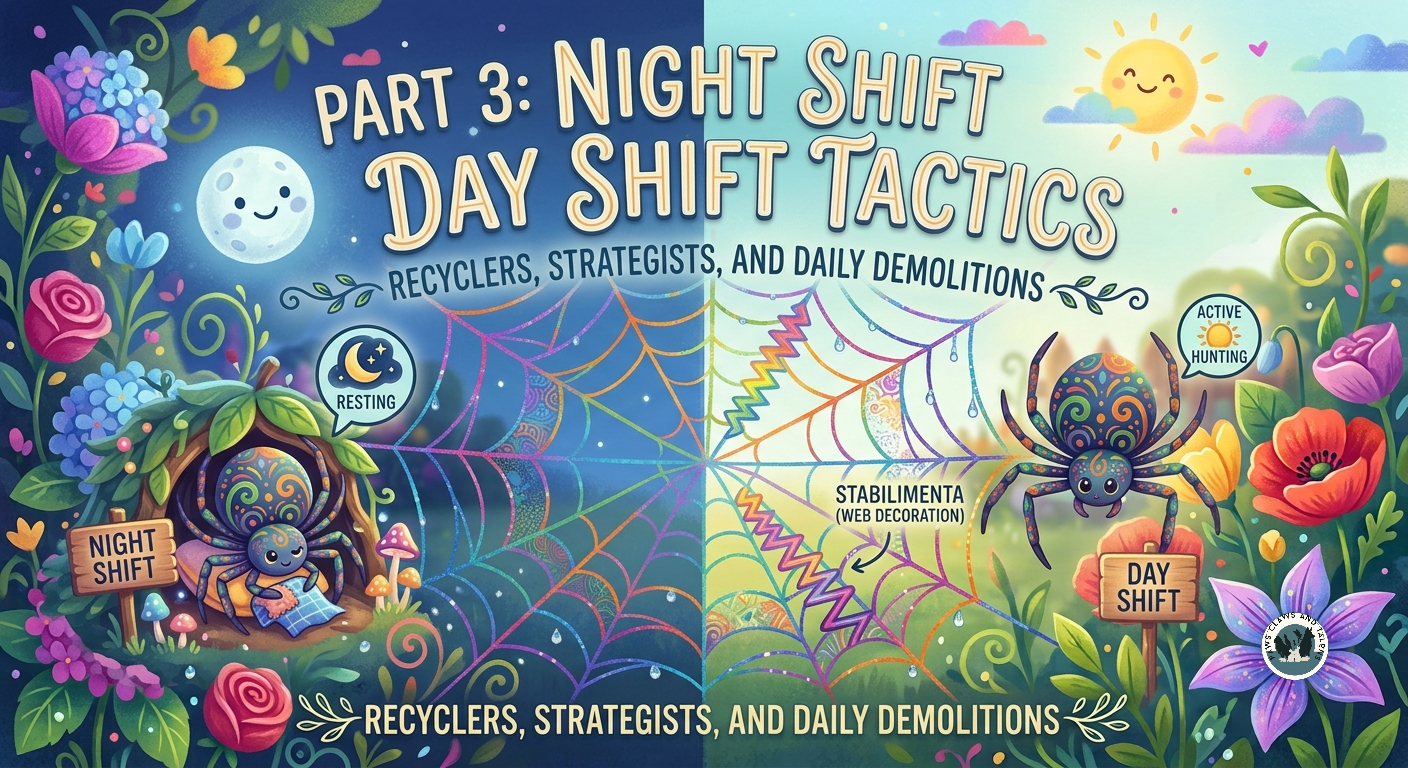
Step outside into the yard at noon, and you might see an orb weaver hanging quietly in the dead center of its web. Step out at midnight with a flashlight, and you might catch that very same spider actively tearing down its entire home or devouring a freshly snared moth. Orb weavers do not operate on a single, uniform schedule. Instead, different species have evolved distinct behavioral shifts—a division between nocturnal craftspeople and diurnal strategists—to maximize their hunting success while staying off the radar of hungry predators.
The Night Shift: Recyclers and Stealth Hunters
A massive group of orb weavers, including many barn spiders and spotted orb weavers, operate almost exclusively under the cover of darkness. This nocturnal schedule is a clever survival mechanism designed to avoid sharp-eyed daytime predators like birds, wasps, and lizards.
- The Midnight Construction: As twilight falls, nocturnal orb weavers emerge from their daytime hiding spots under leaves, tree bark, or house siding. They build an entire, full-sized web in complete darkness, relying entirely on touch and vibration sensors rather than sight to construct perfect geometric shapes.
- The Dawn Demolition: Running a web all day long in the bright sun can dry out sticky silk droplets and leave the spider exposed. To solve this, nocturnal species pull down their webs before sunrise. They systematically dismantle the capture spiral and structural lines, bundling the silk up with their mouthparts and eating it.
- Silk Recycling: Spider silk is rich in protein. By ingesting their old webs, nocturnal orb weavers digest the amino acids and recycle up to ninety percent of the raw materials, using that stored energy to manufacture fresh silk for the next night’s trap.
- Daytime Hiding Out: During daylight hours, these spiders retreat to a sheltered nook near the edge of their web area. They run a single, invisible signal thread from the center of the web location directly to their front legs while hidden, allowing them to rest safely in the shade while keeping a finger on the pulse of their territory.
The Day Shift: Sunlit Strategists and Web Decorations
While nocturnal species hide away, diurnal species—such as yellow garden spiders and spiny-backed orb weavers—thrive in broad daylight. Hunting under a bright sun brings higher risks, but it also opens up access to high-volume day-flying pollinators like flies, bees, and butterflies.
- Sun-Basking Hunters: Day-active orb weavers build large, highly visible webs across open spaces, flower beds, and tall grasses. They spend the entire day sitting directly in the middle of the web at the hub, head down, waiting for prey to strike.
- Web Decorations (Stabilimenta): Many diurnal species weave brilliant, thick zigzag patterns of bright white silk into the center of their webs. Known as stabilimenta, these decorative bands serve multiple strategic purposes. They can reflect ultraviolet light to attract flower-visiting insects, make the web visible to birds so they do not accidentally fly through and destroy the spider’s hard work, and camouflage the spider’s outline against sunlight.
- Heavy-Duty Construction: Unlike their nocturnal cousins who rebuild every night, day-shift weavers build heavy, durable structures designed to last multiple days through wind, heat, and direct sunlight, performing minor patch-ups only when necessary.
Whether working the graveyard shift in complete darkness or monitoring a sunlit web at high noon, the Orb Weaver’s behavioral tactics show just how adaptable these garden allies truly are.
Leave a Reply