
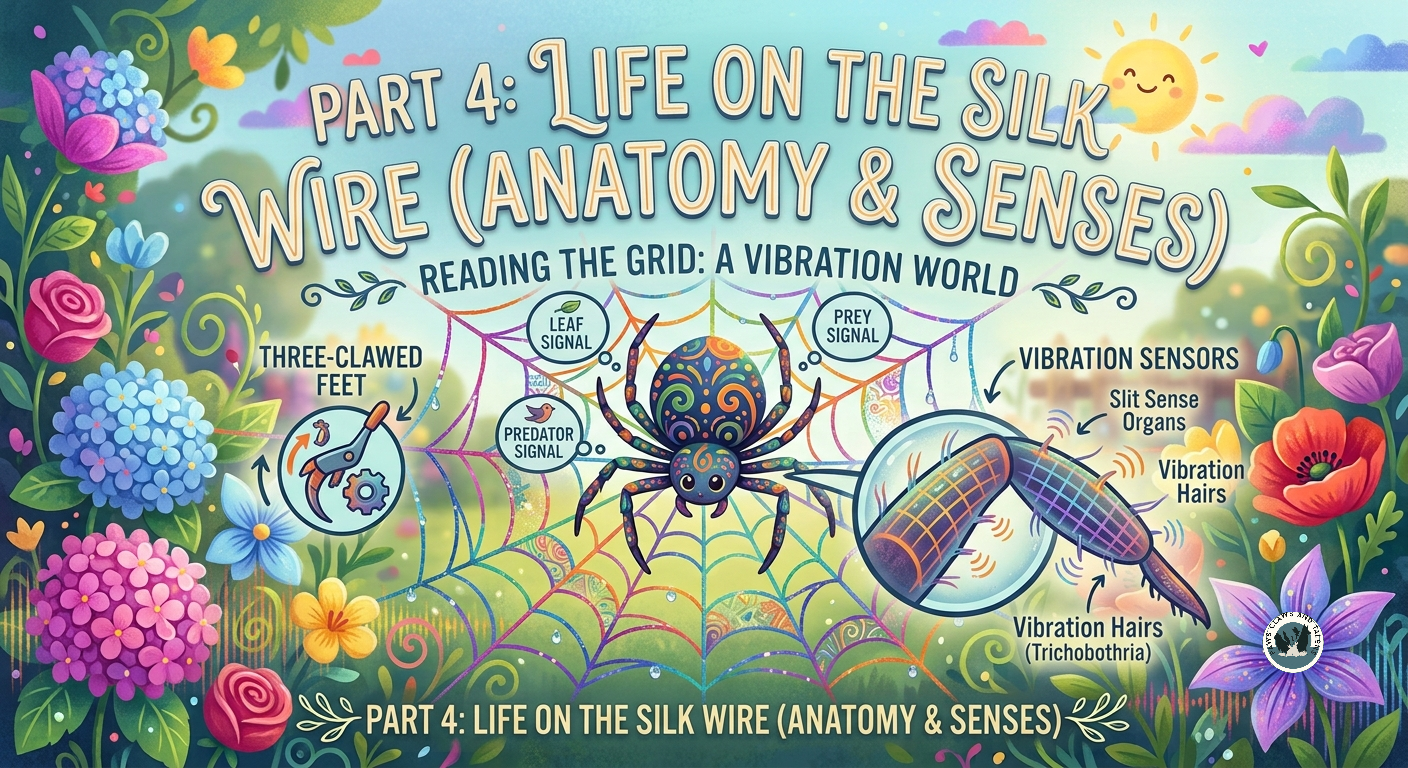
To thrive in a world suspended high above the ground, an orb weaver relies on body features built specifically for wire-walking and high-speed hunting. While humans look at a web and see a beautiful geometric shape, an orb weaver experiences it as an extension of its own nervous system.
Every hair, joint, and leg claw is tuned to process physical data from the surrounding environment.
High-Tech Feet: The Three-Clawed Traps
Unlike hunting spiders that run across flat ground on two main claws, orb weavers carry a specialized third claw on the tip of each leg.
- The Flexible Hook: This middle claw acts like a flexible hook, pinching individual strands of silk to give the spider an unbreakable grip on the web frame.
- Spring-Loaded Release: Specialized, serrated bristles surrounding the claw compress when grabbing silk and spring open when released, allowing the spider to sprint across threads without getting hung up.
- Targeted Balance: These micro-structures allow orb weavers to hang upside down for hours without straining their muscles, hanging effortlessly in the center of the web structure.
Sensing the Grid: World of Vibrations
Despite having eight eyes, most orb weavers have poor eyesight. They do not see the world through sharp visual images; instead, they experience their surroundings through complex vibration patterns traveling across the web grid.
- Slit Sense Organs: Tiny microscopic cracks in the spider’s exoskeleton, called lyriform organs, act as strain gauges. They detect subtle flexes in the silk as an insect struggles against the web.
- Trichobothria (Vibration Hairs): Ultra-sensitive, microscopic hairs covering their legs pick up airborne sound waves and air currents, alerting the spider to approaching predators or flying prey before they even touch the web.
- Reading the Signals: An orb weaver can instantly distinguish between a gentle breeze blowing through the web, a fallen leaf, or the frantic thrashing of a trapped beetle based entirely on frequency and tension changes.
Anatomy Built for Efficiency
The physical silhouette of an orb weaver reflects its specialized lifestyle. Their round, bulbous abdomens house expansive silk production glands, while their powerful, spiny legs pull double duty—plucking web lines like guitar strings to test frame tension and wrapping thrashing prey in heavy silk bandages within seconds of impact.
Leave a Reply