
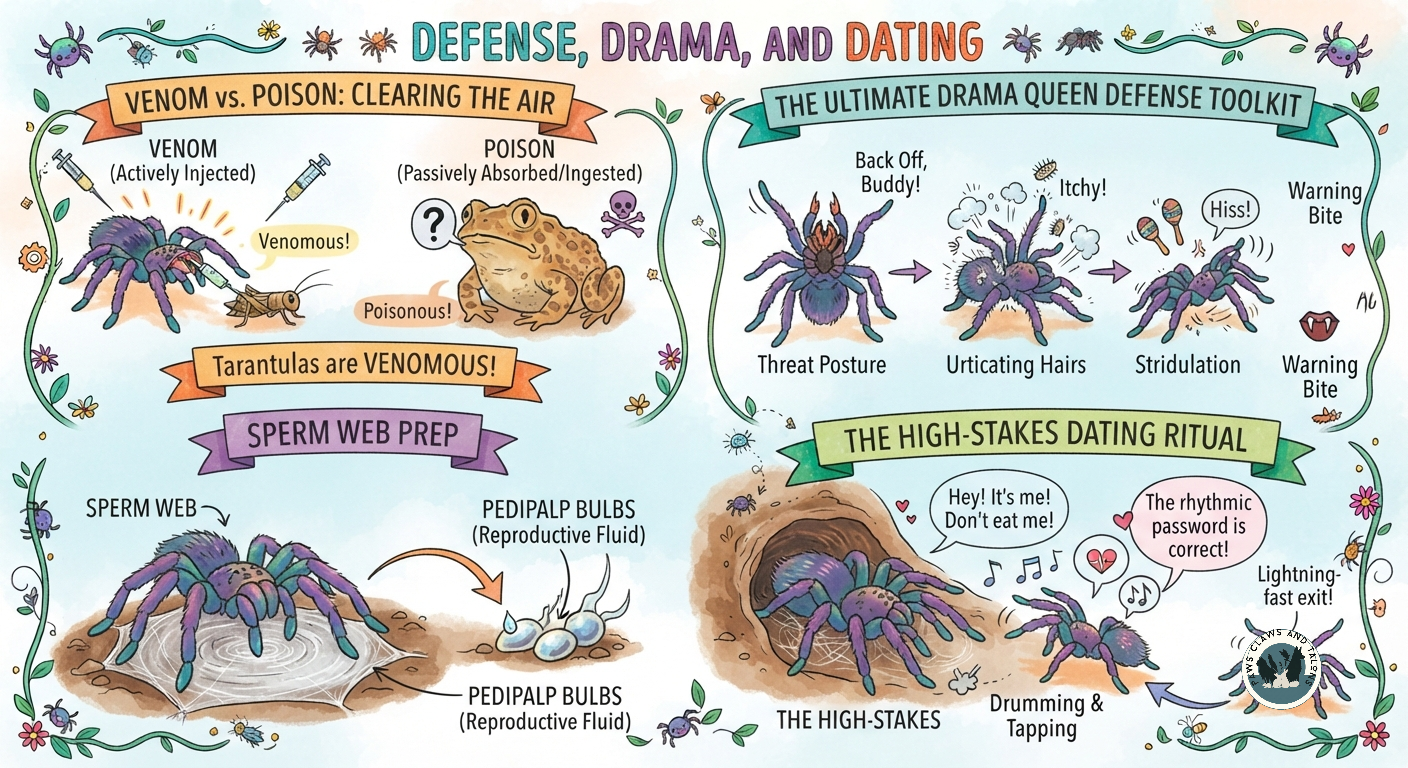

We have traveled across the globe and marveled at their marvelous internal plumbing, but now it is time for the real action. Today we are clearing up some classic misconceptions, looking at their theatrical self-defense toolkits, and diving headfirst into the high-stakes, slightly terrifying soap opera that is tarantula romance.
Venom vs. Poison: Clearing the Air
Before we talk about how these eight-legged dynamos defend themselves, we have to settle a classic debate. People often throw the words venom and poison around like they mean the exact same thing, but in the animal kingdom, they are entirely different business models.
Think of it this way:
- Venom is actively injected. It is delivered directly through specialized weapons like fangs, stingers, or spurs.
- Poison is passively absorbed or ingested. If you bite or eat something and you get sick, that creature is poisonous.
Tarantulas do not want to be eaten, and they certainly are not sitting around waiting for someone to snack on them. Instead, they use their fangs to inject venom into their prey. That makes tarantulas strictly venomous, not poisonous!
The Ultimate Drama Queen Defense Toolkit
When an uninvited guest crosses the line, a tarantula does not just sit there—they put on a whole theatrical production. Depending on whether they are a chill New World diva or a spicy Old World speed demon, their defense toolkit includes:
- The Threat Posture: They rear up on their hind legs, throw their front legs up in the air, and flash those terrifying fangs like a bouncer at an exclusive club, basically shouting, “Back off, buddy!”
- Urticating Hairs: As we mentioned earlier, New World tarantulas have a secret weapon on their rear ends. If threatened, they will use their back legs to furiously scrub their abdomens, kicking up a cloud of microscopic barbed bristles that can cause an intensely annoying itch.
- Stridulation: Some species can actually make a hissing or rustling sound by rubbing specialized bristles on their mouthparts or legs together. It sounds like a tiny, angry maraca telling you to go away.
- A Warning Bite: Reserved as an absolute last resort, because venom is precious and making fangs work hard takes energy.
Tarantula Romance: High Stakes and Heavy Sighs
Now for the pièce de résistance: the dating scene. If you think modern romance is stressful, imagine being a male tarantula trying to impress a lady who is easily twice your size and could view you as an appetizer rather than a soulmate.
When a male tarantula reaches maturity, he spins a special sperm web—a small, reinforced mat of silk where he deposits a drop of reproductive fluid and reabsorbs it into specialized bulbs on his pedipalps (those cute little front feelers). Once loaded up, he sets off on a dangerous quest to find a mature female’s burrow, guided entirely by her chemical scent trails.
When he arrives, he has to announce his presence very carefully. Male tarantulas perform an elaborate ritual of drumming and tapping with their front legs and pedipalps. It is essentially a rhythmic acoustic password that tells the female, “Hey! It’s me! Don’t eat me, I’m here for love!”
If she is receptive, she will tap back. If she is not in the mood (or if he messes up his rhythm), the date ends abruptly with the male becoming a very expensive, high-protein snack. But if the rhythm is right, he uses his pedipalps to safely transfer the fluid, and then he makes a lightning-fast exit stage left before she changes her mind.
And there you have it, chaos wranglers! From global real estate and liquid lunches to high-drama dating rituals, tarantulas prove that the most fascinating creatures are often the ones lurking quietly in the shadows.