
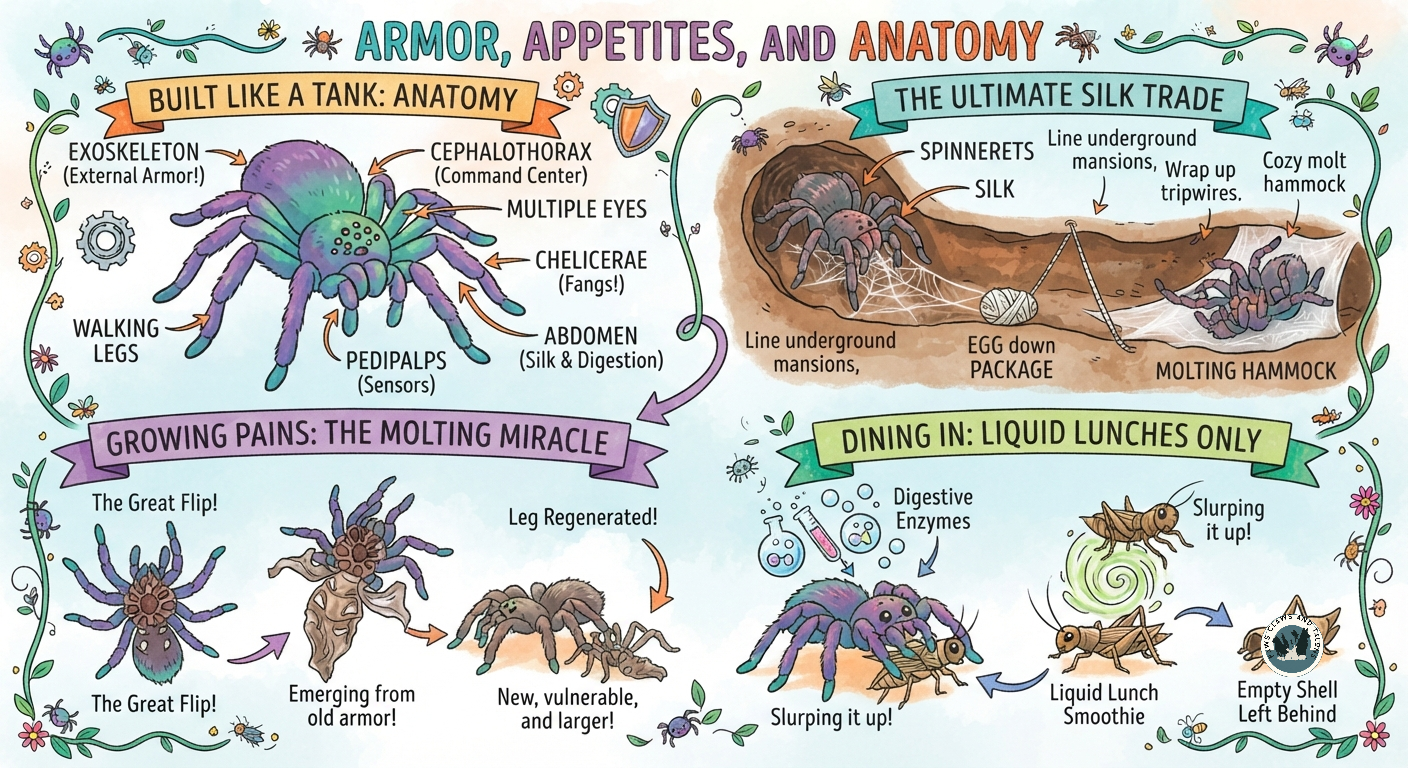
If you thought learning about where tarantulas live was an adventure, prepare to have your mind blown by what is actually going on underneath all those fuzzy legs. Today we are cracking open the blueprint of these eight-legged marvels to explore their fabulous armor, their sneaky silk operations, and their rather unconventional dining habits.
Built Like a Tank: The Anatomy and the Suit of Armor
Let us start with their birthday suit, which is also their suit of armor. Unlike us soft-skinned humans, tarantulas wear their skeletons on the outside. This outer shell is called an exoskeleton (which is just a fancy science term for an external skeleton), and it acts like a customized suit of knight’s armor. It protects them from bumps and bruises and keeps them from drying out in the big wide world.
Up front, you have the cephalothorax—a combination of the head and thorax fused together into one handy command center. This is where you will find their multiple little eyes, their walking legs, their pedipalps (which look like a cute extra pair of mini-legs used for sensing and handling things), and the main event: their chelicerae. These are the powerful mouthparts that hold their fangs, which fold up like pocketknives when they are not in use. Attached to the back end is the abdomen, which is basically the factory floor for silk production and digestion.
The Ultimate Silk Trade
Speaking of silk, people often picture tarantulas spinning classic web-catchers in the corner of a room, but these creatures are high-end interior designers. They use specialized organs at the rear end called spinnerets to spin silk for completely different reasons.
They do not usually weave sticky webs to trap flying bugs. Instead, they use their silk to line their underground mansions, wrap up their eggs like precious little holiday packages, lay down tripwires to sense when an unsuspecting cricket is wandering by, and create a cozy hammock to molt safely. It is less like a spiderweb and more like laying down expensive wall-to-wall carpeting.
Growing Pains: The Great Molting Miracle
Because a tarantula’s armor is made of a tough, inflexible material, they cannot just grow bigger inside of it like putting on a larger shirt. When they outgrow their old clothes, they have to go through ecdysis—the official biological term for shedding an exoskeleton.
This process is the ultimate high-stakes drama. The tarantula flips completely upside down on its back, looking for all the world like it has met its demise, and slowly works its way out of its old skin. When it emerges, it is soft, incredibly vulnerable, and slightly larger than before. It takes a few days for the new armor to harden up. Bonus superpower: if they lost a leg in a previous scuffle, molting gives them the incredible ability to regenerate a brand-new one!
Dining In: Liquid Lunches Only
Finally, let us talk about how these ambush predators fuel up. Tarantulas do not have teeth to chew their food, which means they cannot sit down for a nice crunchy sandwich. Instead, they catch their prey—ranging from crickets to small insects—using their venom and fangs, and then they inject powerful digestive enzymes (specialized chemical juices) right into the meal.
These enzymes basically turn the inside of the prey into a pre-digested, nutrient-rich smoothie. Once the meal has been thoroughly liquefied, the tarantula slurps it all up, leaving behind nothing but a neat, hollow shell. It is a little bit spooky, wildly efficient, and honestly kind of impressive.
Leave a Reply