
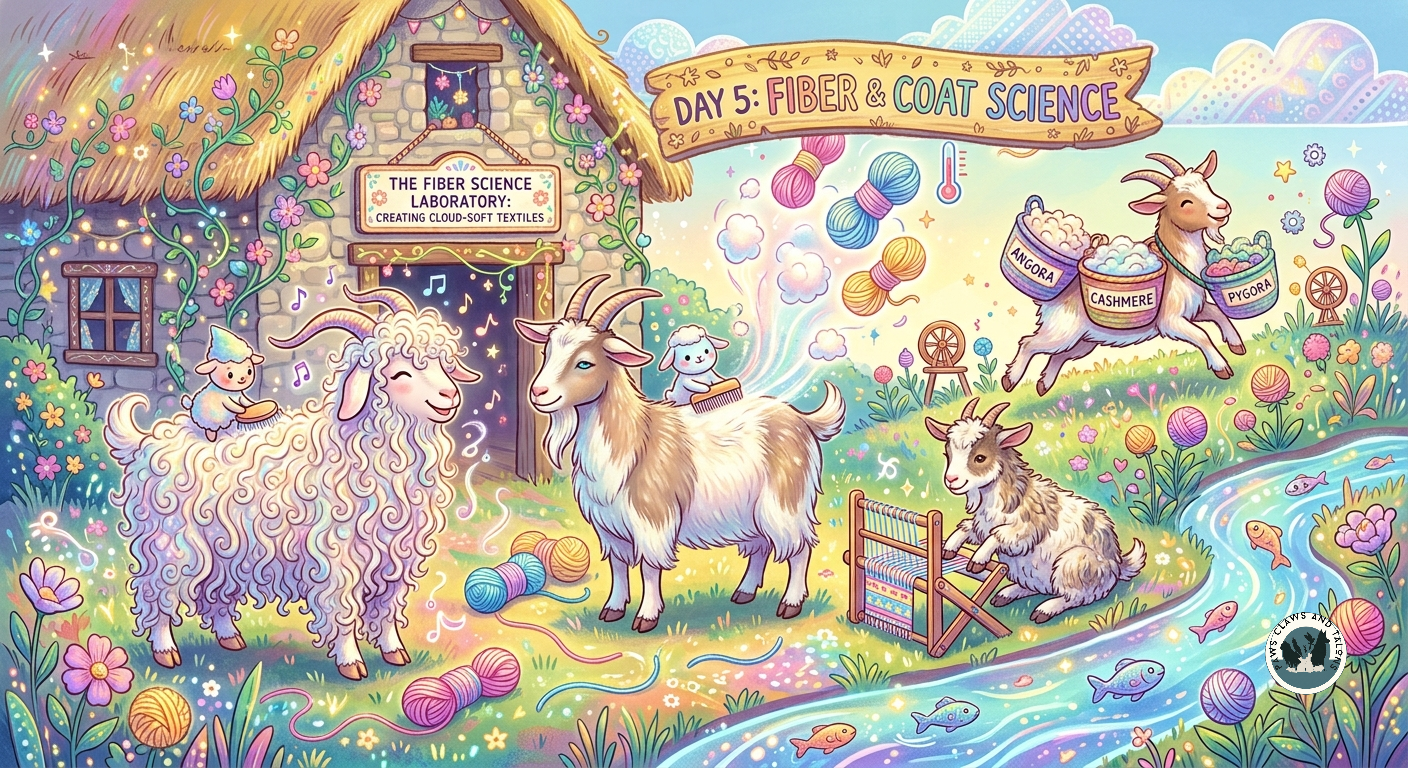
Welcome to Day 5 of our goat feature week. After exploring working goats in the field yesterday, today we pivot to the soft, warm, and highly sought-after world of natural textiles.
While many domestic livestock breeds are raised for dairy or meat, specific goat breeds produce some of the most luxurious natural fibers on earth. From silky mohair to cloud-soft cashmere, goat fiber science combines evolutionary biology with high-end textile arts.
Mohair: The Lustrous Locks of the Angora Goat
Originating from the Ankara region of Turkey, the Angora goat is famous for producing mohair. Unlike sheep wool, mohair is incredibly smooth, strong, and naturally flame-resistant.
Angora goats grow ringlets of wavy fiber that continuously lengthen throughout the year. Because their fleece lacks the distinct microscopic scales found in sheep wool, mohair does not felt easily, giving it a characteristic silky sheen and vibrant dye retention. Fiber artists and textile manufacturers prize mohair for its warmth, durability, and lightweight breathability.
Angora goats are sheared twice a year, yielding several pounds of rich fleece during each harvest while remaining active, healthy members of the herd.
Cashmere: The Soft Undercoat of Winter Protection
Unlike Angora goats, which represent a specific breed, cashmere is not tied to a single breed of goat. Instead, cashmere refers to the ultra-fine downy undercoat grown by almost any goat breed living in cold, harsh climates.
As winter approaches, goats develop a dual-layer coat:
- Guard Hairs: A coarse outer layer that sheds rain, snow, and dirt while protecting the skin.
- Cashmere Down: An extremely fine, crimped inner layer trapped beneath the guard hairs, creating dead air pockets that hold body heat.
To qualify as true cashmere, these inner fibers must measure under 19 microns in diameter—roughly one-sixth the width of a human hair. Instead of shearing, cashmere is traditionally gathered during spring shedding by gently combing out the soft undercoat, leaving the guard hair behind. It takes the annual fleece harvest of four to six goats to craft a single cashmere sweater.
Pygora Goats: The Best of Both Worlds
For small-scale homesteaders and hand-spinners, crossbreeding produced the Pygora goat—a deliberate cross between a registered Pygmy goat and a registered Angora goat.
Pygoras combine the compact size, friendly personality, and easy management of miniature breeds with versatile fleece production. Depending on individual genetics, Pygora fiber ranges from silky, mohair-like ringlets to ultra-soft cashmere-type down, making them a favorite among natural fiber enthusiasts.
Tomorrow, we transition to life cycles, growth milestones, and kid development in Day 6: Breeding, Kids, and Life Stages.
Leave a Reply