
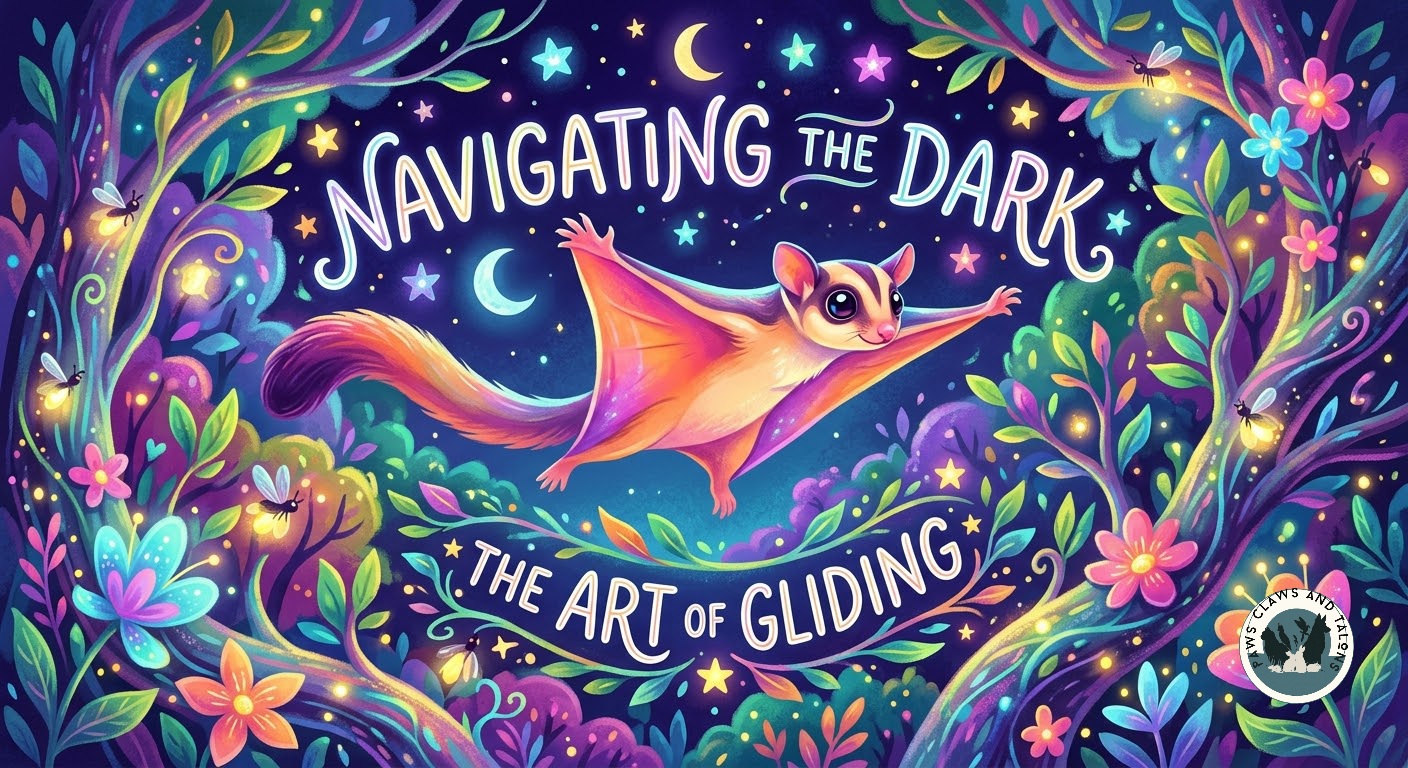
Imagine standing on a branch high in the forest canopy, gazing into pitch-black night, and launching yourself into the void toward a tree fifty feet away. For a sugar glider, this isn’t a daredevil stunt—it is standard nightly commute. Watching a sugar glider move through the treetops feels less like watching an animal fall and more like watching a tiny, living aircraft pilot its way through the leaves. Their movement through the air is entirely controlled, highly calculated, and dependent on a combination of biomechanics and sharp sensory adaptations fine-tuned for life in the dark.
Calculating the Leap: Pre-Flight Prep and Launch
Long before a sugar glider actually leaves a branch, its brain is hard at work running complex flight calculations. If you have ever observed a glider right before a leap, you may have noticed them rapidly bobbing their head up and down or side to side. This behavior isn’t nervousness; it is stereoscopic triangulation. Because their eyes are set fixed in their sockets, moving their head rapidly creates subtle shifts in perspective, allowing them to map out exact distances and depth in three-dimensional space before taking off.
Once the target is locked in, powerful hind legs propel the glider forward into the air. The instant their feet leave the bark, they spread all four limbs wide. This immediate expansion pulls the patagium taut, transforming their sleek body into a broad, flat lifting surface that catches the air currents instantly.
Steering Mechanics: Mid-Air Control
Sailing through the air is only half the battle when navigating a dense forest full of branches and trunks. Sugar gliders actively steer, bank, and brake mid-flight using subtle anatomical shifts. By raising or lowering a wrist or ankle, a glider alters the tension on one side of its patagium, instantly shifting the airflow to curve gracefully around obstacles or line up a precise landing path.
Their long, bushy tail plays a critical role in these mid-air maneuvers. While not prehensile enough to hang from branches, the tail acts as a dynamic rudder and counterweight during flight. Swinging the tail left or right helps tilt the body to execute sharp turns, while swooping the tail upward right before impact shifts their angle of attack. This creates a parachute effect that slows their forward momentum, allowing them to land softly on all four paws with virtually no sound.
Seeing in the Shadows: Nocturnal Vision and Spatial Awareness
Executing pinpoint landings on rough tree bark requires exceptional visual equipment when ambient light is scarce. A sugar glider’s eyes are massive relative to its head size, perfectly adapted to trap every available photon of moonlight or starlight. Their retinas are heavily packed with rod cells, the light-sensitive photoreceptors responsible for low-light vision and detecting motion in the dark.
In addition to their light-gathering eyes, gliders possess extremely long, delicate facial whiskers. As a glider approaches a landing site, these tactile sensors fan out to detect changes in air pressure and warn the animal of small twigs or leaves immediately in front of its face. This combination of high-sensitivity vision and facial radar ensures they stick every landing safely, even when leaping blind into dense leaf cover.
Moving Into the Colony Life
A sugar glider’s ability to calculate distances, adjust flight paths in mid-air, and read the dark forest canopy makes them incredible individual navigators. However, in the wild, these glides are rarely solo flights. These acrobatic journeys are part of a larger team effort, as gliders live and hunt in highly organized groups.
Now that we have explored how sugar gliders navigate the physical world around them, our next post turns to the complex social world inside the nest. Next week, we will step inside the tree hollow to break down sugar glider colony structure, alpha hierarchies, and how these nocturnal flyers work together to survive.
Leave a Reply