
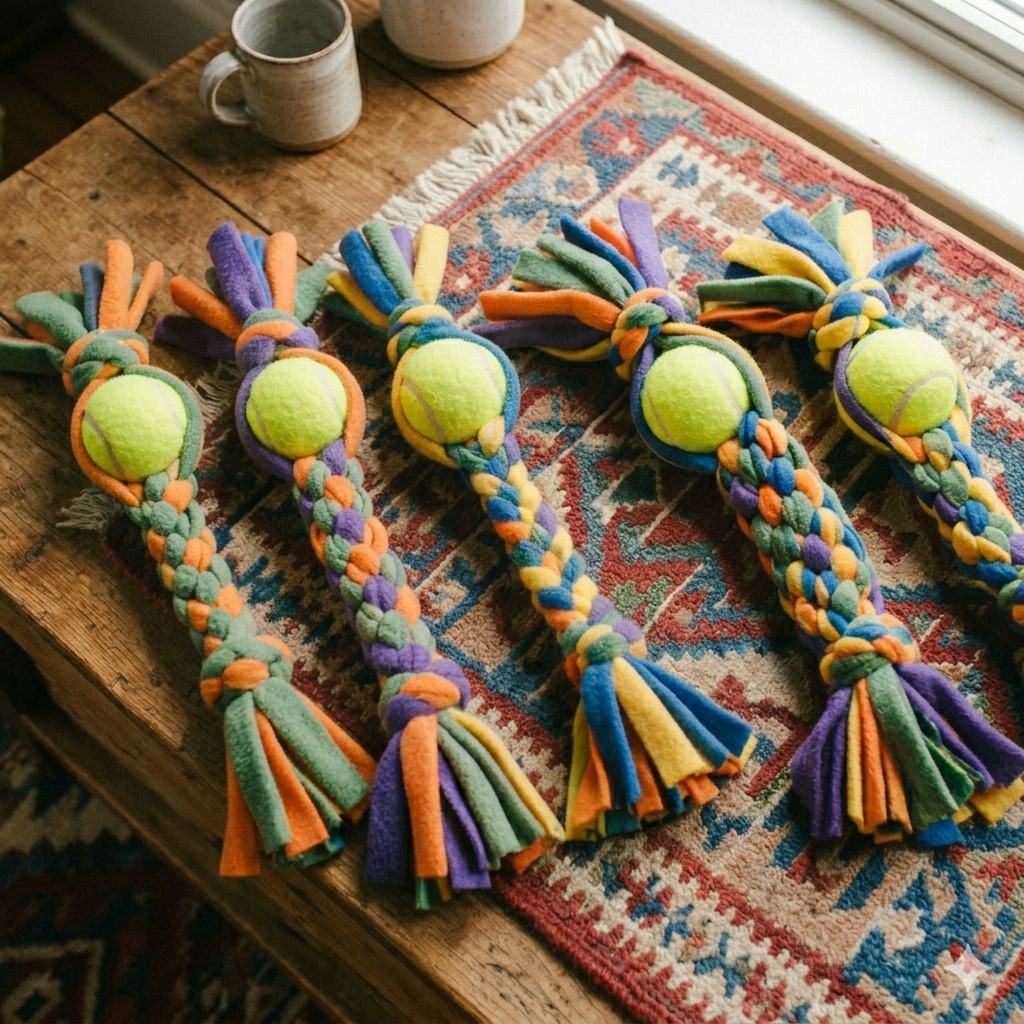
Protocol: The Kinetic Tension Lattice (KTL)
Institutional Role: Proprioceptive & Dental Enrichment
Stewardship Level: Advanced (The Textile Architects)
Validation: Multi-Strand High-Torque / Reinforced Core
The Kinetic Tension Lattice (KTL) is a high-performance, manual-interface asset engineered for the Biological Engine’s high-energy inhabitants. Moving beyond the “recreational rope,” this protocol utilizes complex braiding geometries and integrated spherical ballasts to facilitate muscular development and jaw-alignment stability. It is a prestigious, institution-grade instrument designed for heavy-duty engagement.
The Material Specifications
| Component | Institutional Role | Function |
| High-Density Upcycled Fleece | The Primary Weave | Moisture-wicking, non-abrasive textile strips used for the main structural braid. |
| Spherical Pressurized Polymer | The Kinetic Anchor | Standard-duty tennis balls integrated at the terminal or medial points for weight-balance. |
| Internal High-Tensile Spine | The Structural Core | A secondary, reinforced cord hidden within the braid to prevent longitudinal failure. |
| Friction-Lock Terminals | The Tension Seal | Heat-shrunk or double-knotted ends designed to resist unraveling during high-torque events. |
Assembly Instructions for Textile Architects
1. Calibrating the Material Gradient
Select three distinct color-coded fleece strips to represent the different “Logic Teams” or departments within the institution. Each strip must be cut to a precise width of 3 inches to ensure the final braid achieves the necessary structural density.
2. Executing the Triple-Helix Braid
Secure the strips through a pre-drilled aperture in the Kinetic Anchor. Employ a high-tension triple-helix braiding technique. Unlike standard loose weaves, this institutional method requires consistent 15-pound tension per cross-over to eliminate internal air pockets and increase the “bite-resistance” of the finished asset.
3. Integrating the Secondary Ballast
At the midpoint of the lattice, thread the weave through a second Spherical Pressurized Polymer. This creates a dual-axis center of gravity, allowing the resident to engage in “shake-and-toss” behaviors without the asset losing its aerodynamic profile.
4. The Terminal Locking Protocol
Finish the distal end with a double-pass friction knot. The remaining “fringe” should be trimmed to exactly 4 inches, serving as a tactile sensory interface for the resident while protecting the primary structural knots from direct dental contact.
5. Institutional Sanitization & Deployment
Subject the completed KTL to a high-pressure steam cycle at 100°C to lock the fibers and remove any chemical residues from the manufacturing process. Once dry, the asset is validated for deployment within the high-energy testing zones.
Resident Candidate List: High-Energy Logic Teams
Canidae Athletic Divisions (Working Dogs)
The primary beneficiaries of the Kinetic Tension Lattice. The KTL provides a high-torque outlet for jaw strength and neck muscle conditioning during supervised training intervals.
Viverridae Enrichment Teams (Large Mustelids/Ferret Colonies)
Utilize the smaller-scale KTL variants for communal “tug-of-war” protocols, fostering social cohesion and physical agility within the habitat.
Psittacidae Cognitive Teams (Large Parrots)
When suspended vertically, the KTL serves as a textured climbing conduit, allowing residents to utilize their beaks and talons to navigate complex vertical environments.
 Paws, Claws and Talons Foundation